


Blogs
From hours in documents to seconds: How AI can close the compliance gap in regulated industries
Whether you work in banking, insurance, healthcare or energy, every compliance team knows the feeling: multiple documents open on the screen, hundreds of pages each, and the job is to find the one line where your internal policy quietly diverges or does not cover what the regulator actually requires. It is slow, error-prone and easy to miss. This is exactly the kind of work AI can now accelerate: accurately, with full evidence, and built around your own documents.
Compliance isn't a search problem. It's two problems.
Institutions mentioned above operate in heavily regulated environments where internal policies are expected to mirror hundreds of regulations arising from directives and supervisory guidelines. It becomes time-consuming to go through one document after another, trying to navigate the legal terms. On top of that, internal policies need to be up to date since one overlooked gap can result in significant fines. Compliance work has two problems.
-
The first is finding the right answer which means knowing which document, which section, which article, across hundreds of pages of regulatory text.
-
The second is understanding it once you get there.
How we approach it
Most compliance tools approach this as a mapping exercise where they extract a list of requirements from a regulation, then check whether your policies cover them. But regulations are rarely that straightforward. The real difficulty lies in the parts that are hard to pin down: ambiguous language, partial overlaps, requirements that are technically present but not quite right.
This grey area is what we built an AI-powered compliance assistant for. It matches relevant regulations with your internal policies and surfaces the near-misses and subtle differences, which puts you the compliance officer, in the position to decide whether those differences matter.
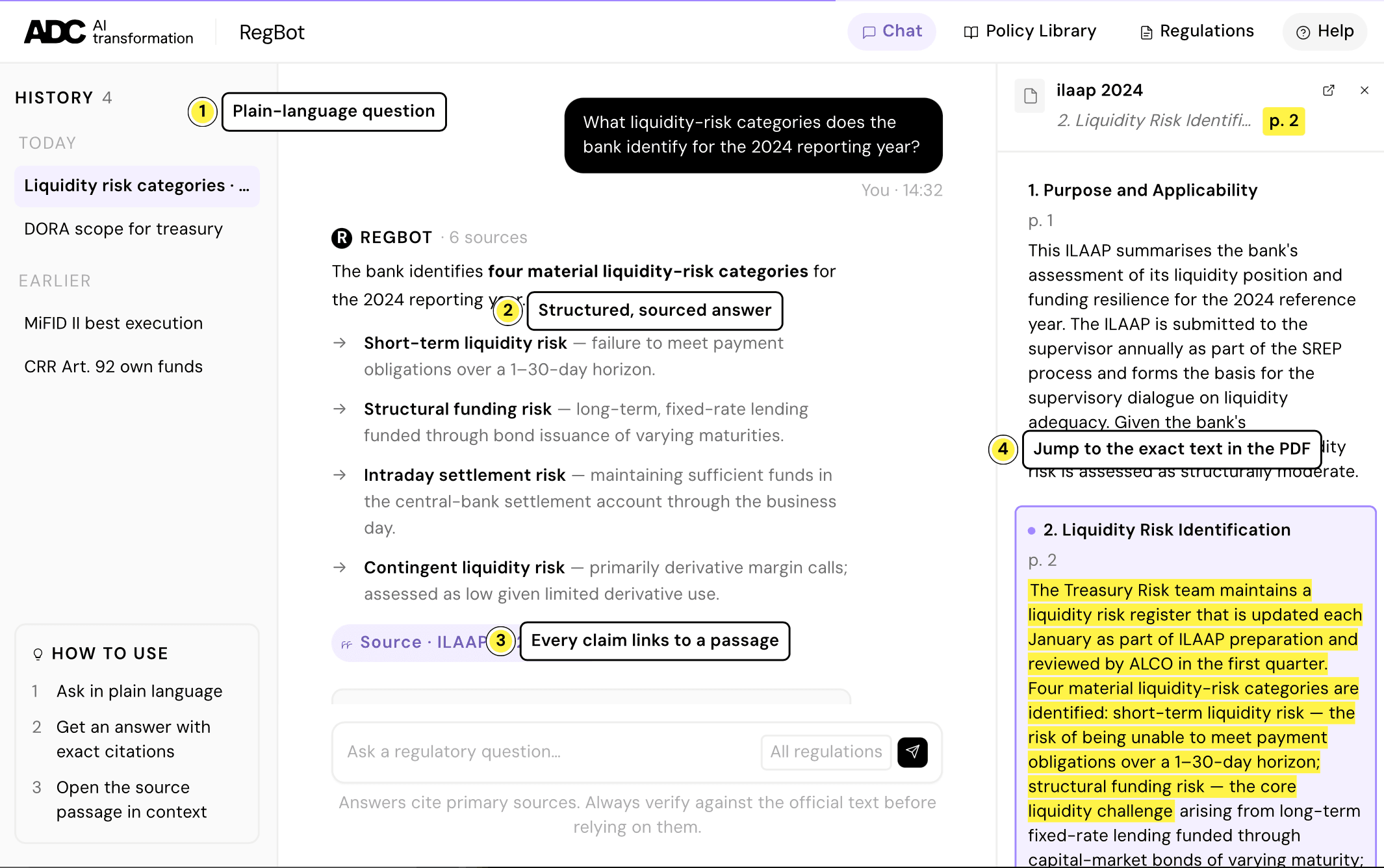
Every answer links back to evidence. You are not trusting a black magic box. You can follow the reasoning, see exactly which parts of your documents it draws from, and verify the answer yourself.
The assistant does this through three capabilities:
1. Chat with your library
Ask anything you want about your policies and regulations, and the assistant will answer based solely on what is in your library. Every answer is backed by a full evidence trail, so you always know exactly where the information comes from.
2. Automatic gap detection
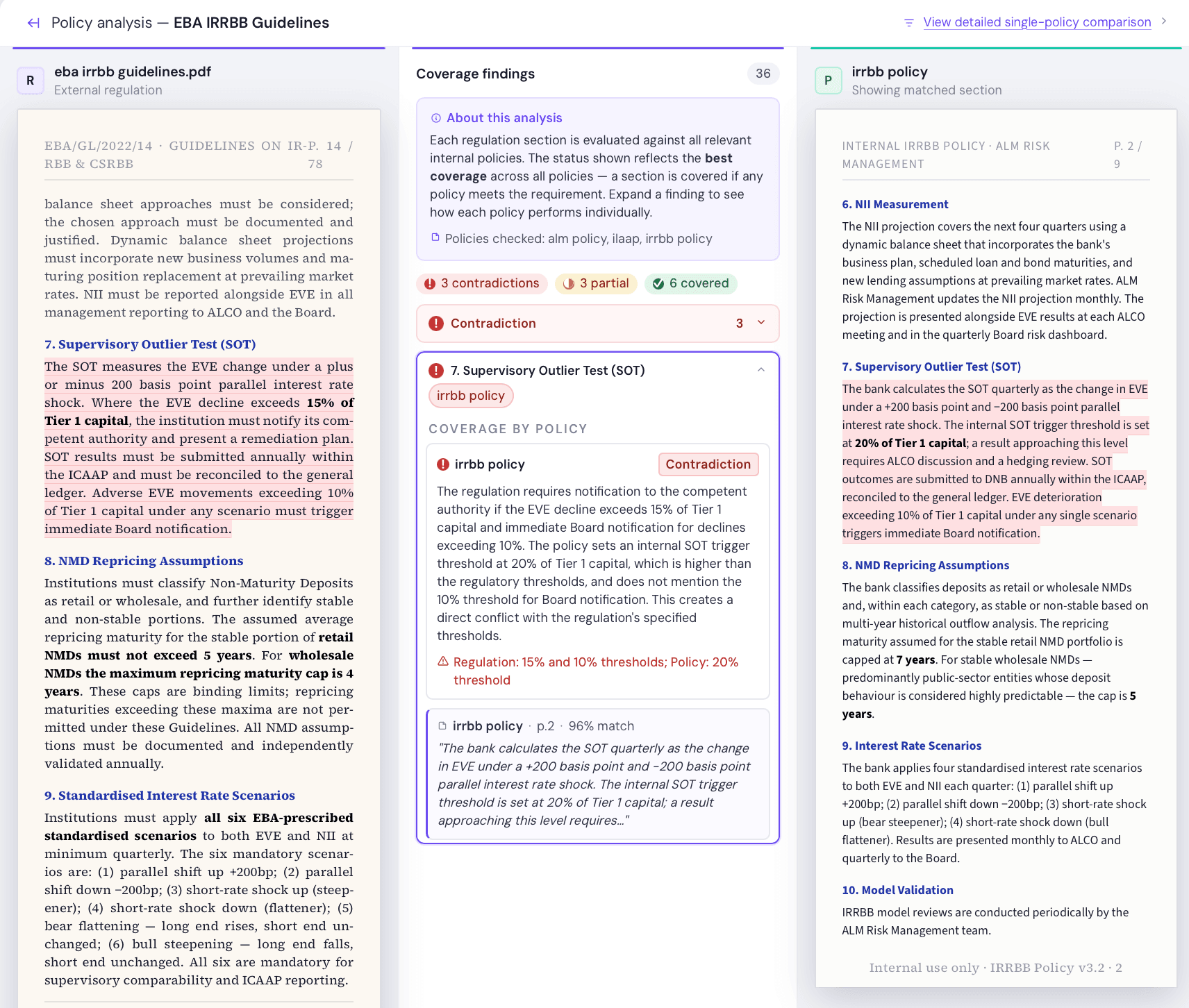
Map an external regulation against your policy library or a single internal policy to stay on top of your compliance obligations.
Run a policy comparison so that your AI assistant analyses both policies and guidelines to surface gaps automatically. It maps every requirement against your policy and colour-codes the result, so you can immediately see where to look closer. Click on any finding and the assistant jumps straight to the highlighted section in both documents side by side, so you can trace every classification back to its source.
What you get is context: the matched sections, the classifications, the relevant passages side by side. Whether a difference is material is a judgement call, and by design, that call stays with you.
3. Regulatory news feed
Regulations change constantly. The assistant monitors live regulatory publications from the issuing bodies that matter to you, so updates don't slip past your team. You can also chat with any article directly to work through what it means for your policies.
Grounded in your documents, nothing else
The tool makes use of a RAG (Retrieval-Augmented Generation) technology.
When a document is uploaded, the system breaks it into small sections and gives each one a kind of "meaning fingerprint". When you ask a question, it gets the same treatment and the most relevant sections are handed to our AI model, which writes an answer grounded specifically in those documents. On top of that, we apply a regulatory interpretation layer that assesses whether the matched section is assessing what the regulation requires and not just whether it mentions the same topic.
With RAG, our AI-powered compliance assistant does not guess or rely on general knowledge. It is specifically instructed to work only with the retrieved passages and nothing outside them. It cites its sources; shows the exact passage it is drawing from and provides the evidence with page number and section. If the answer is not in the documents, it says so.
Built for your organisation
The assistant isn't a product built once for every regulated institution. ADC builds it around your specific policy house, the regulations that apply to your organisation, the way your documents are structured, and the workflows your compliance team already uses. That means no irrelevant frameworks cluttering the picture, and no generic interpretations of rules that affect your business in a very specific way. The result is a tool that fits the specifics of your business rather than averaging across an industry.
In practice, that means:
● Gaps surfaced in minutes rather than weeks of manual cross-referencing
● A private deployment that meets data residency and GDPR requirements from the start
● A living, searchable knowledge base rather than a folder of static documents
The tools in this space are evolving quickly. What matters is not finding the perfect product off a shelf but finding the right approach for your organisation, built on technology that is transparent, evidence-based, and genuinely useful to the people doing the work.
Continue the conversation:
At ADC, we have a proven track record of delivering end-to-end GenAI products in complex, regulated environments.
If you are curious to see our tool in action for your organisation, we would be happy to walk you through a live demo and explore how it could fit into your compliance workflows.
Get in touch with Diederik Fokkema or follow ADC on LinkedIn for more insights on practical AI in regulated industries.
Whether you work in banking, insurance, healthcare or energy, every compliance team knows the feeling: multiple documents open on the screen, hundreds of pages each, and the job is to find the one line where your internal policy quietly diverges or does not cover what the regulator actually requires. It is slow, error-prone and easy to miss. This is exactly the kind of work AI can now accelerate: accurately, with full evidence, and built around your own documents.
Compliance isn't a search problem. It's two problems.
Institutions mentioned above operate in heavily regulated environments where internal policies are expected to mirror hundreds of regulations arising from directives and supervisory guidelines. It becomes time-consuming to go through one document after another, trying to navigate the legal terms. On top of that, internal policies need to be up to date since one overlooked gap can result in significant fines. Compliance work has two problems.
-
The first is finding the right answer which means knowing which document, which section, which article, across hundreds of pages of regulatory text.
-
The second is understanding it once you get there.
How we approach it
Most compliance tools approach this as a mapping exercise where they extract a list of requirements from a regulation, then check whether your policies cover them. But regulations are rarely that straightforward. The real difficulty lies in the parts that are hard to pin down: ambiguous language, partial overlaps, requirements that are technically present but not quite right.
This grey area is what we built an AI-powered compliance assistant for. It matches relevant regulations with your internal policies and surfaces the near-misses and subtle differences, which puts you the compliance officer, in the position to decide whether those differences matter.
Every answer links back to evidence. You are not trusting a black magic box. You can follow the reasoning, see exactly which parts of your documents it draws from, and verify the answer yourself.
The assistant does this through three capabilities:
1. Chat with your library
Ask anything you want about your policies and regulations, and the assistant will answer based solely on what is in your library. Every answer is backed by a full evidence trail, so you always know exactly where the information comes from.
2. Automatic gap detection
Map an external regulation against your policy library or a single internal policy to stay on top of your compliance obligations.
Run a policy comparison so that your AI assistant analyses both policies and guidelines to surface gaps automatically. It maps every requirement against your policy and colour-codes the result, so you can immediately see where to look closer. Click on any finding and the assistant jumps straight to the highlighted section in both documents side by side, so you can trace every classification back to its source.
What you get is context: the matched sections, the classifications, the relevant passages side by side. Whether a difference is material is a judgement call, and by design, that call stays with you.
3. Regulatory news feed
Regulations change constantly. The assistant monitors live regulatory publications from the issuing bodies that matter to you, so updates don't slip past your team. You can also chat with any article directly to work through what it means for your policies.
Grounded in your documents, nothing else
The tool makes use of a RAG (Retrieval-Augmented Generation) technology.
When a document is uploaded, the system breaks it into small sections and gives each one a kind of "meaning fingerprint". When you ask a question, it gets the same treatment and the most relevant sections are handed to our AI model, which writes an answer grounded specifically in those documents. On top of that, we apply a regulatory interpretation layer that assesses whether the matched section is assessing what the regulation requires and not just whether it mentions the same topic.
With RAG, our AI-powered compliance assistant does not guess or rely on general knowledge. It is specifically instructed to work only with the retrieved passages and nothing outside them. It cites its sources; shows the exact passage it is drawing from and provides the evidence with page number and section. If the answer is not in the documents, it says so.
Built for your organisation
The assistant isn't a product built once for every regulated institution. ADC builds it around your specific policy house, the regulations that apply to your organisation, the way your documents are structured, and the workflows your compliance team already uses. That means no irrelevant frameworks cluttering the picture, and no generic interpretations of rules that affect your business in a very specific way. The result is a tool that fits the specifics of your business rather than averaging across an industry.
In practice, that means:
● Gaps surfaced in minutes rather than weeks of manual cross-referencing
● A private deployment that meets data residency and GDPR requirements from the start
● A living, searchable knowledge base rather than a folder of static documents
The tools in this space are evolving quickly. What matters is not finding the perfect product off a shelf but finding the right approach for your organisation, built on technology that is transparent, evidence-based, and genuinely useful to the people doing the work.
Continue the conversation:
At ADC, we have a proven track record of delivering end-to-end GenAI products in complex, regulated environments.
If you are curious to see our tool in action for your organisation, we would be happy to walk you through a live demo and explore how it could fit into your compliance workflows.
Get in touch with Diederik Fokkema or follow ADC on LinkedIn for more insights on practical AI in regulated industries.
Talk to our experts
Let's create real impact together with data and AI

Principal, Financial Services
Diederik Fokkema
Talk to our experts
Let's create real impact together with data and AI
Principal, Financial Services
Diederik Fokkema