

Pricing for customers who decide in seconds: Why selling to your customers starts with understanding them
Date
July 8, 2026
A typical person makes 35,000 decisions a day. Most are invisible: which foot to lead with, which hand grabs the door handle. But a meaningful decision, one where you actually process information and make a choice, takes about five to seven seconds.
In retail, pricing is one of those decisions. For every product, in every market, someone has to decide what it costs. Multiply that by thousands of products across dozens of countries and the scale becomes staggering.
Walmart and Amazon treat pricing as a real-time decision
Walmart is rolling out digital shelf labels across all 2,300 U.S. stores by the end of 2026, replacing paper tags and letting prices update from a central system instead of by hand. Amazon updates prices across large parts of its assortment throughout the day, using data to respond to demand, competition and market conditions. Both companies treat pricing as a strategic lever, not something that gets reviewed once a quarter.
Most pricing teams are stuck between gut feel and competitor-matching
Most retailers sit somewhere between full automation and gut-feel spreadsheets, and they tend to fall into one of two patterns.
1. The first is the aggregator. A pricing team at a fashion retailer with hundreds of stores across thirty markets simply doesn't have the hours to price product by product. So they group: everything in this category gets 20% off, everything in that one gets 30%. It's a blunt instrument, but it's the only one that fits the time available. The result is that products with very different demand curves get the same discount, and margin quietly leaks out of the products that didn't need the cut. After Petr Pushkar, Lead Decision Scientist at ADC, described this pattern at a recent conference, a pricing lead came up to him afterwards and said: "You just described my job."
2. The second is the matcher. A pricing team selling fast-moving consumer goods online builds their entire strategy around the competition. They watch what other retailers do and react.
Everyone matches, everyone drops, and margins disappear without anyone making a conscious decision to let them.
As Petr puts it: "You're not selling to your process and you're not selling to your competitors. You're selling to your customers."
Customers now compare, decide and buy in seconds
These patterns are running into a customer who has changed. People use ChatGPT to compare products before they've opened a single brand website. They buy directly on TikTok, where a trend can go from zero to sold out in a week and be forgotten the week after. On Instagram, influencers move products faster than any promotional calendar could plan for.
Most pricing strategies were built for a slower world. The gap between how fast customers decide and how fast pricing teams can respond is exactly where the problem lives.
Not every discount moves demand the same way
This is where price elasticity comes in: how strongly customer demand changes when the price changes. Customer response follows a curve and understanding that curve is what separates a discount that works from one that simply gives margin away.
One common shape looks like this. The exact contours differ by product and category, but the principle holds.
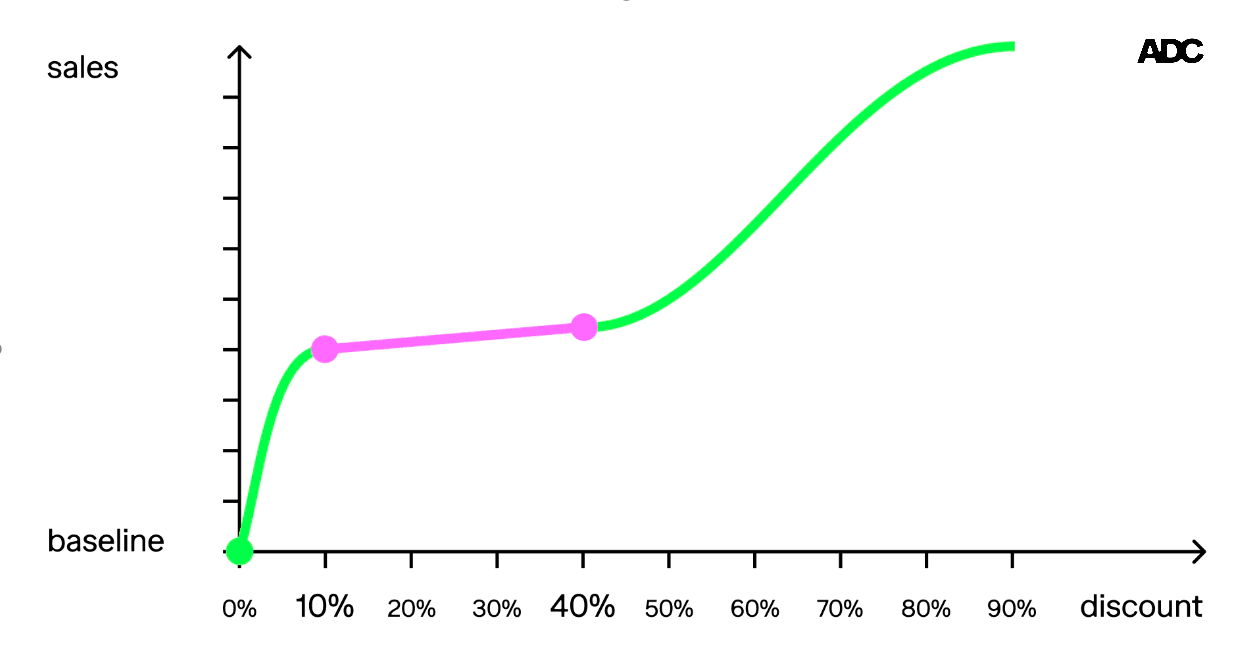
Give a small discount, say up to 10%, and sales can jump. The red label grabs attention, online and in store. Between 10% and 40% off, the curve often flattens. Customers see the discount, but it doesn't really change what they do. In their minds, there may be no meaningful difference between 20% off and 35% off, going deeper costs you margin without selling more. Demand only picks up again at very deep discounts, up to 90% off, when the goal shifts from making profit to simply clearing stock.
Price affects sales - but so does the weather, your competitors, and the news cycle
On the surface, the relationship between price and sales looks straightforward. Lower the price, sell more. But that's only part of the picture, because in reality sales are driven by a lot more than just price.
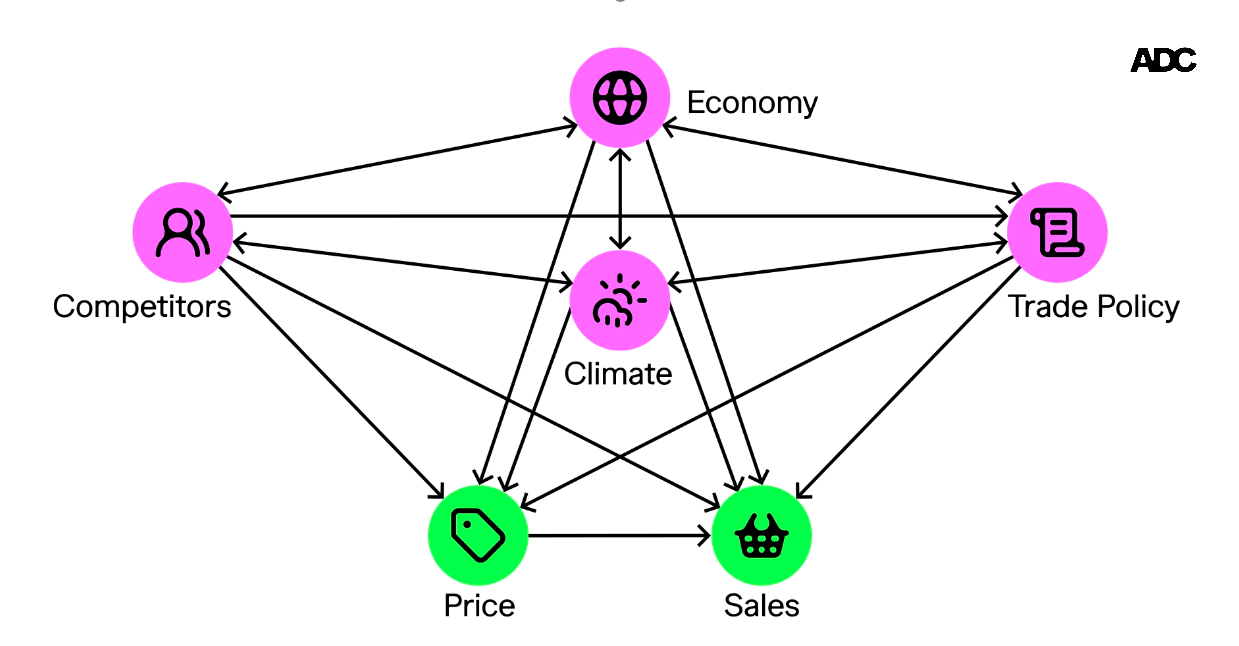
As you can see, the economy, your competitors, the weather, trade policy: they all push price and sales in different directions at the same time. So, when you look at your data, you're not just seeing what your pricing did. You're seeing your pricing mixed up with a heatwave, a news cycle, and whatever your biggest competitor decided to do that week.
Superdry experienced this firsthand. Their underlying profit fell 49% in the first half of 2018, and management pointed directly at unseasonably warm weather, which wiped out demand for their autumn and winter range.
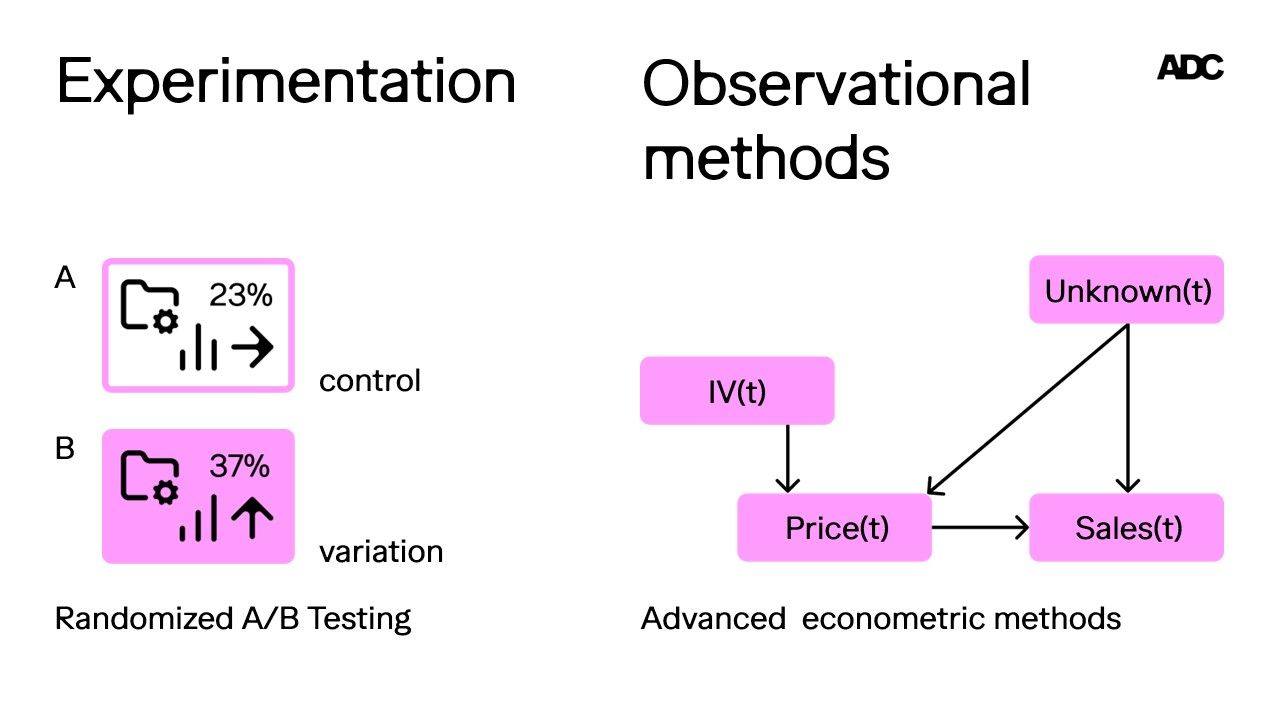
At the same time, A/B testing price effects is harder than it sounds. Customers don't like seeing two prices for the same product, and even when you can run the test, the results are hard to trust because too many other things are happening at the same time.
The right model separates price from everything else moving with it
ADC uses observational econometrics: statistical models that work with your existing sales data to separate the effect of price from everything else. No experiments needed, and no inconsistent prices for customers to notice.
And because we measure at product level rather than category level, the insights are actually useful. A 20% discount might be exactly right for one product and completely unnecessary for the one sitting next to it on the shelf.
Build, buy, or partner: how to find the right path
Not every retailer needs to build their own pricing model from scratch. If pricing is urgent but not a strategic priority, buying an off-the-shelf tool makes sense. If it's strategic but there's no rush, building it yourself over time is a reasonable path. When pricing is both important and urgent, that's when partnering tends to deliver the fastest results.
What Hunkemöller learned when they stopped pricing on instinct
Working with Hunkemöller on their first elasticity-based markdown campaign, the results were clear. • +12.5% more profit than human-led decisions • Average discounts were 4–5 percentage points lower • They sold a comparable number of units
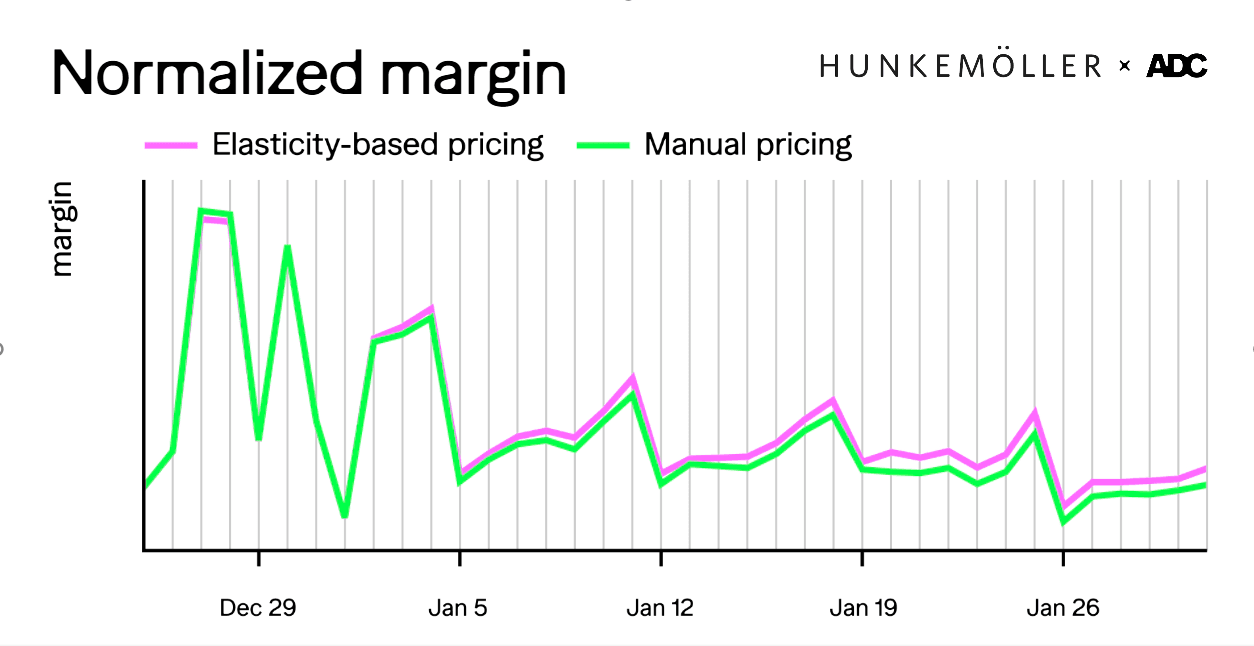
The margin graph tells the story. Manual pricing started stronger; aggressive early discounts moved stock fast. But that speed came at a cost. By mid-January, the elasticity-based approach had pulled ahead and the gap kept widening, with more money coming in every day.
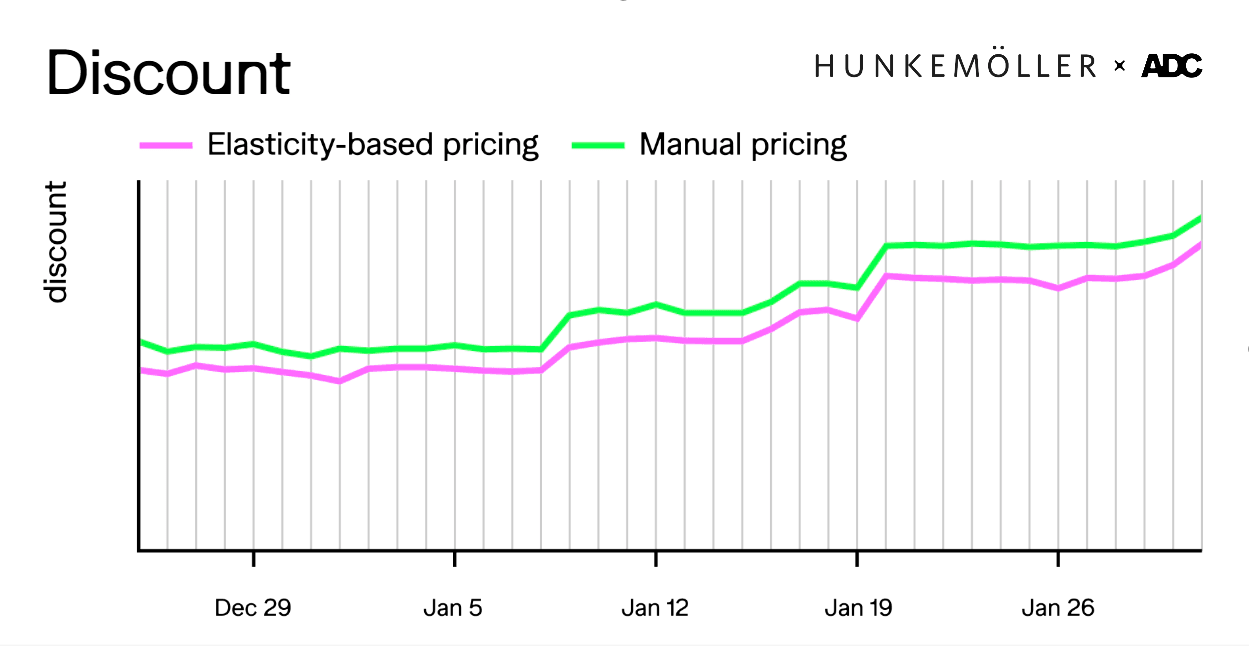
The discount graph explains why. Manual pricing kept pushing discounts higher as the campaign went on, while the elasticity-based approach stayed lower and steadier, applying discounts only where the data showed they would actually change what customers did. It didn't win on day one. It won by being right every day after that. In the end, it's a marathon, not a sprint.
"You don't need to control every price. You need to control how prices behave."
Date
July 8, 2026
A typical person makes 35,000 decisions a day. Most are invisible: which foot to lead with, which hand grabs the door handle. But a meaningful decision, one where you actually process information and make a choice, takes about five to seven seconds.
In retail, pricing is one of those decisions. For every product, in every market, someone has to decide what it costs. Multiply that by thousands of products across dozens of countries and the scale becomes staggering.
Walmart and Amazon treat pricing as a real-time decision
Walmart is rolling out digital shelf labels across all 2,300 U.S. stores by the end of 2026, replacing paper tags and letting prices update from a central system instead of by hand. Amazon updates prices across large parts of its assortment throughout the day, using data to respond to demand, competition and market conditions. Both companies treat pricing as a strategic lever, not something that gets reviewed once a quarter.
Most pricing teams are stuck between gut feel and competitor-matching
Most retailers sit somewhere between full automation and gut-feel spreadsheets, and they tend to fall into one of two patterns.
1. The first is the aggregator. A pricing team at a fashion retailer with hundreds of stores across thirty markets simply doesn't have the hours to price product by product. So they group: everything in this category gets 20% off, everything in that one gets 30%. It's a blunt instrument, but it's the only one that fits the time available. The result is that products with very different demand curves get the same discount, and margin quietly leaks out of the products that didn't need the cut. After Petr Pushkar, Lead Decision Scientist at ADC, described this pattern at a recent conference, a pricing lead came up to him afterwards and said: "You just described my job."
2. The second is the matcher. A pricing team selling fast-moving consumer goods online builds their entire strategy around the competition. They watch what other retailers do and react.
Everyone matches, everyone drops, and margins disappear without anyone making a conscious decision to let them.
As Petr puts it: "You're not selling to your process and you're not selling to your competitors. You're selling to your customers."
Customers now compare, decide and buy in seconds
These patterns are running into a customer who has changed. People use ChatGPT to compare products before they've opened a single brand website. They buy directly on TikTok, where a trend can go from zero to sold out in a week and be forgotten the week after. On Instagram, influencers move products faster than any promotional calendar could plan for.
Most pricing strategies were built for a slower world. The gap between how fast customers decide and how fast pricing teams can respond is exactly where the problem lives.
Not every discount moves demand the same way
This is where price elasticity comes in: how strongly customer demand changes when the price changes. Customer response follows a curve and understanding that curve is what separates a discount that works from one that simply gives margin away.
One common shape looks like this. The exact contours differ by product and category, but the principle holds.
Give a small discount, say up to 10%, and sales can jump. The red label grabs attention, online and in store. Between 10% and 40% off, the curve often flattens. Customers see the discount, but it doesn't really change what they do. In their minds, there may be no meaningful difference between 20% off and 35% off, going deeper costs you margin without selling more. Demand only picks up again at very deep discounts, up to 90% off, when the goal shifts from making profit to simply clearing stock.
Price affects sales - but so does the weather, your competitors, and the news cycle
On the surface, the relationship between price and sales looks straightforward. Lower the price, sell more. But that's only part of the picture, because in reality sales are driven by a lot more than just price.
As you can see, the economy, your competitors, the weather, trade policy: they all push price and sales in different directions at the same time. So, when you look at your data, you're not just seeing what your pricing did. You're seeing your pricing mixed up with a heatwave, a news cycle, and whatever your biggest competitor decided to do that week.
Superdry experienced this firsthand. Their underlying profit fell 49% in the first half of 2018, and management pointed directly at unseasonably warm weather, which wiped out demand for their autumn and winter range.
At the same time, A/B testing price effects is harder than it sounds. Customers don't like seeing two prices for the same product, and even when you can run the test, the results are hard to trust because too many other things are happening at the same time.
The right model separates price from everything else moving with it
ADC uses observational econometrics: statistical models that work with your existing sales data to separate the effect of price from everything else. No experiments needed, and no inconsistent prices for customers to notice.
And because we measure at product level rather than category level, the insights are actually useful. A 20% discount might be exactly right for one product and completely unnecessary for the one sitting next to it on the shelf.
Build, buy, or partner: how to find the right path
Not every retailer needs to build their own pricing model from scratch. If pricing is urgent but not a strategic priority, buying an off-the-shelf tool makes sense. If it's strategic but there's no rush, building it yourself over time is a reasonable path. When pricing is both important and urgent, that's when partnering tends to deliver the fastest results.
What Hunkemöller learned when they stopped pricing on instinct
Working with Hunkemöller on their first elasticity-based markdown campaign, the results were clear. • +12.5% more profit than human-led decisions • Average discounts were 4–5 percentage points lower • They sold a comparable number of units
The margin graph tells the story. Manual pricing started stronger; aggressive early discounts moved stock fast. But that speed came at a cost. By mid-January, the elasticity-based approach had pulled ahead and the gap kept widening, with more money coming in every day.
The discount graph explains why. Manual pricing kept pushing discounts higher as the campaign went on, while the elasticity-based approach stayed lower and steadier, applying discounts only where the data showed they would actually change what customers did. It didn't win on day one. It won by being right every day after that. In the end, it's a marathon, not a sprint.
"You don't need to control every price. You need to control how prices behave."
Talk to our experts
Let's create real impact together with data and AI

Senior Manager, Retail
Petr Pushkar
Talk to our experts
Let's create real impact together with data and AI
Senior Manager, Retail
Petr Pushkar