


Blogs
Agentic code migration: turning lingering legacy to state-of-the-art software
Challenge: the hidden cost of letting legacy systems linger
Nearly every company that has been around for more than a few years has legacy code trapped in outdated platforms. Migrating a codebase to a new language, dialect, or platform is tedious, time consuming, and often risky, so it’s frequently postponed.
"If I force my team to migrate all 21 models, I am afraid I do not have a team left at the end of the year" - Product owner at Dutch bank
Legacy systems stick around not because they are irreplaceable, but because migrating them is a high-effort, low-appeal task. However, the consequences are more than an inconvenience. Developers are forced to work with and learn outdated syntax, costly licenses are retained longer than necessary, and companies miss out on the efficiency gains and features of state-of-the-art tools and platforms.
Our solution: turning complex migrations into a guided agentic workflow
One of the latest breakthroughs in generative AI is the rise of coding agents. Driven by a combination of better reasoning models, larger context windows and enablement of agentic coding workflows, these agents are now finally powerful enough to support full-scale migrations and are easily integrated into your coding Integrated Development Environment (IDE), such as VS Code.
These agents consist of Large Language Models adapted and trained specifically on code generation and coding tasks, with specialised system prompts. These specialised agents can analyse, understand, and rewrite code.
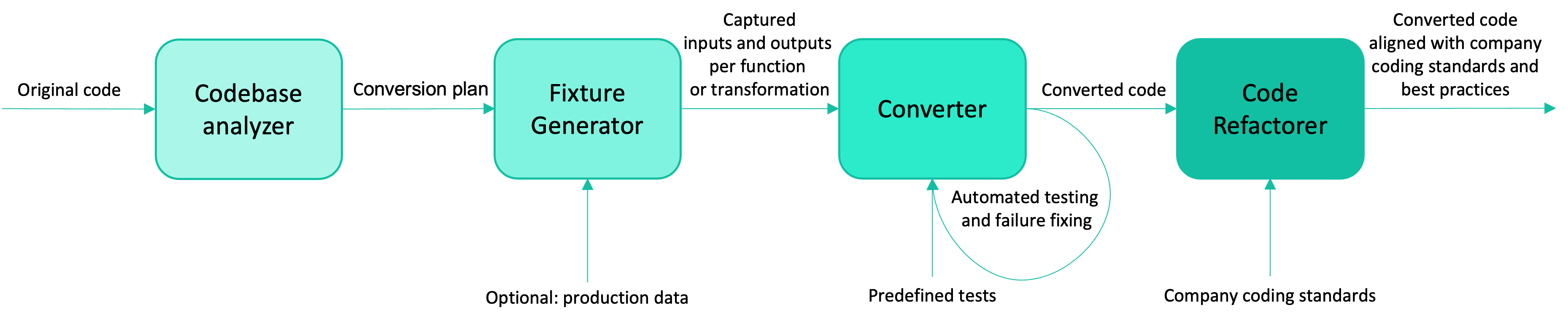
Migrating large repositories is no simple task, even for humans. Successful migration requires understanding the repository’s structure, script interactions, core functions or transformations, and possible inputs and outputs. To tackle this complexity, we break migrations into structured steps, with dedicated agents handling specific subtasks.
The Codebase Analyser determines entry points and their full call chain, leaf functions or transformations, input arguments, output arguments, optional or default arguments of functions or transformations as well as external toolbox or package dependencies and data input and/or output files. This is used by the agent to define a conversion plan.
The Fixture Generator captures the inputs and outputs per original function or transformation, either by using real data or by generating synthetic data including special cases such as empty or large arrays and missing values, infinite values, and negative values.
The Converter performs the conversion from one language, dialect, or platform to the other. To verify its conversion output, the converter uses predefined tests such as unit, regression, and functional tests. These tests, with allowed fault tolerance, are designed together with client stakeholders. The converter iterates on functions or transformations until all the tests pas.
Finally, the Code Refactorer aligns the converted code with company coding standards and best practices.
Together, these agents make it possible to migrate repositories in a matter of hours up to a few days instead of months or even years, depending on repository size, complexity, programming language, and legacy platform.
Turning agentic migration risks into managed guardrails
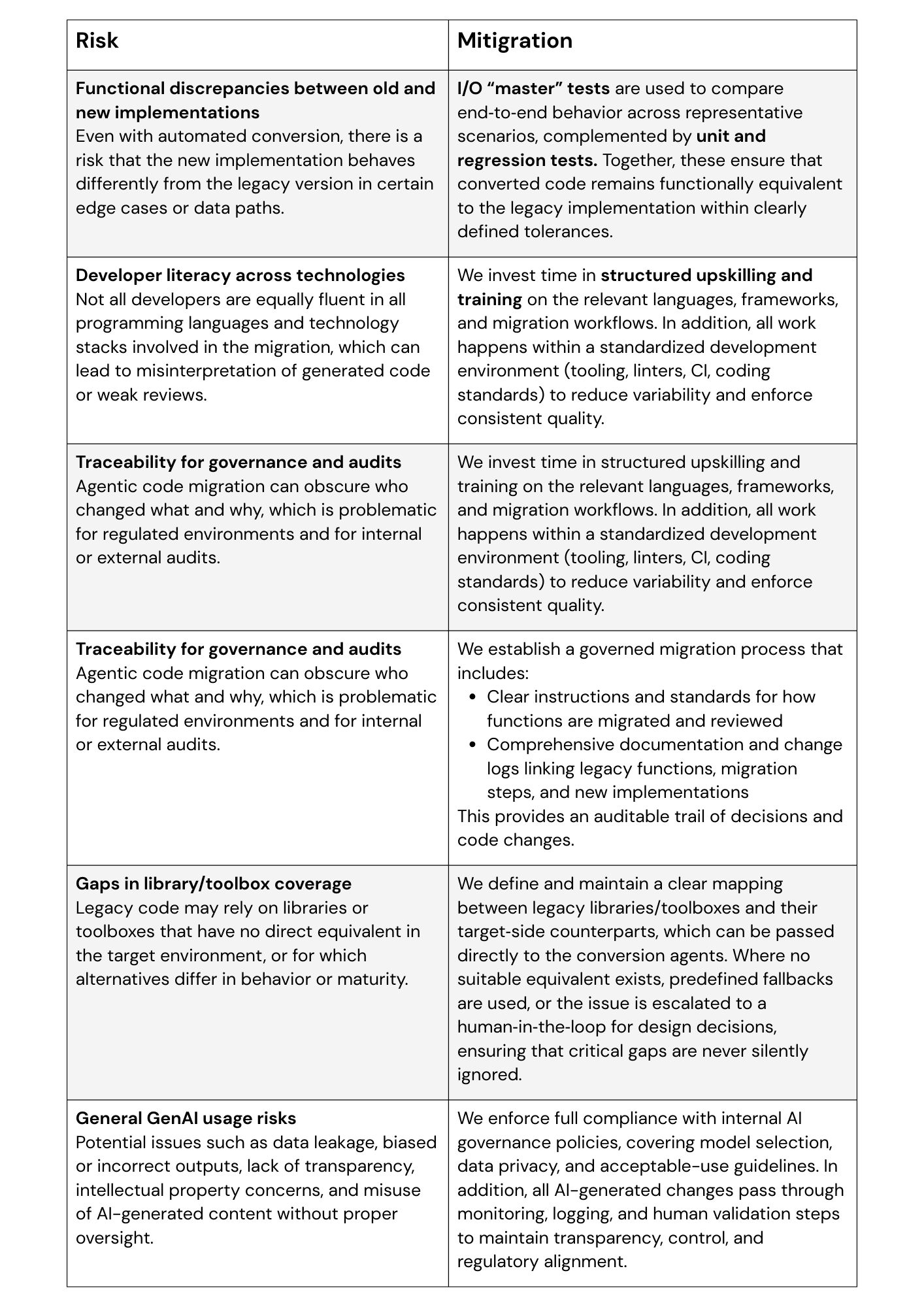
Done well, AI‑supported migration can actually reduce risk compared to manual rewrites. We created a clear risk overview, including mitigation strategies, to make those risks visible, manageable, and acceptable for teams and regulators alike.
In our experience, no two companies or code ecosystems are the same. This makes every migration project unique. By combining our overarching learnings with deep technical expertise and understanding of your business context, we design custom agentic migration workflows tailored to your environment and regulatory requirements. This approach lets companies leverage the power of agentic systems, even in heavily regulated industries, while minimising risk and disruption.
Legacy code does not have to linger. With agentic migration, companies can continuously evolve their software toward state-of-the-art systems without burning out their teams or breaking compliance.
Continue the conversation
At ADC, we have a proven track record of running large-scale transformation programmes and delivering end-to-end GenAI products in complex, regulated environments. That experience is what allows us to turn agentic migration from a promising concept into a reliable, production grade capability for our clients.
If you’d like to receive a demo of our solution or explore how we can help you tackle similar challenges, please contact Edward Janssen (Technology & Innovation Lead) or Henriette Claus (Financial Services Lead).
Challenge: the hidden cost of letting legacy systems linger
Nearly every company that has been around for more than a few years has legacy code trapped in outdated platforms. Migrating a codebase to a new language, dialect, or platform is tedious, time consuming, and often risky, so it’s frequently postponed.
"If I force my team to migrate all 21 models, I am afraid I do not have a team left at the end of the year" - Product owner at Dutch bank
Legacy systems stick around not because they are irreplaceable, but because migrating them is a high-effort, low-appeal task. However, the consequences are more than an inconvenience. Developers are forced to work with and learn outdated syntax, costly licenses are retained longer than necessary, and companies miss out on the efficiency gains and features of state-of-the-art tools and platforms.
Our solution: turning complex migrations into a guided agentic workflow
One of the latest breakthroughs in generative AI is the rise of coding agents. Driven by a combination of better reasoning models, larger context windows and enablement of agentic coding workflows, these agents are now finally powerful enough to support full-scale migrations and are easily integrated into your coding Integrated Development Environment (IDE), such as VS Code.
These agents consist of Large Language Models adapted and trained specifically on code generation and coding tasks, with specialised system prompts. These specialised agents can analyse, understand, and rewrite code.
Migrating large repositories is no simple task, even for humans. Successful migration requires understanding the repository’s structure, script interactions, core functions or transformations, and possible inputs and outputs. To tackle this complexity, we break migrations into structured steps, with dedicated agents handling specific subtasks.
The Codebase Analyser determines entry points and their full call chain, leaf functions or transformations, input arguments, output arguments, optional or default arguments of functions or transformations as well as external toolbox or package dependencies and data input and/or output files. This is used by the agent to define a conversion plan.
The Fixture Generator captures the inputs and outputs per original function or transformation, either by using real data or by generating synthetic data including special cases such as empty or large arrays and missing values, infinite values, and negative values.
The Converter performs the conversion from one language, dialect, or platform to the other. To verify its conversion output, the converter uses predefined tests such as unit, regression, and functional tests. These tests, with allowed fault tolerance, are designed together with client stakeholders. The converter iterates on functions or transformations until all the tests pas.
Finally, the Code Refactorer aligns the converted code with company coding standards and best practices.
Together, these agents make it possible to migrate repositories in a matter of hours up to a few days instead of months or even years, depending on repository size, complexity, programming language, and legacy platform.
Turning agentic migration risks into managed guardrails
Done well, AI‑supported migration can actually reduce risk compared to manual rewrites. We created a clear risk overview, including mitigation strategies, to make those risks visible, manageable, and acceptable for teams and regulators alike.
In our experience, no two companies or code ecosystems are the same. This makes every migration project unique. By combining our overarching learnings with deep technical expertise and understanding of your business context, we design custom agentic migration workflows tailored to your environment and regulatory requirements. This approach lets companies leverage the power of agentic systems, even in heavily regulated industries, while minimising risk and disruption.
Legacy code does not have to linger. With agentic migration, companies can continuously evolve their software toward state-of-the-art systems without burning out their teams or breaking compliance.
Continue the conversation
At ADC, we have a proven track record of running large-scale transformation programmes and delivering end-to-end GenAI products in complex, regulated environments. That experience is what allows us to turn agentic migration from a promising concept into a reliable, production grade capability for our clients.
If you’d like to receive a demo of our solution or explore how we can help you tackle similar challenges, please contact Edward Janssen (Technology & Innovation Lead) or Henriette Claus (Financial Services Lead).
Talk to our experts
Let's create real impact together with data and AI

Technology & Innovation Lead
Edward Jansen

Financial Services Lead
Henriette Claus
Talk to our experts
Let's create real impact together with data and AI
Technology & Innovation Lead
Edward Jansen
Financial Services Lead
Henriette Claus