

Blogs
100 Women, One Conversation With Emilie Lundbye Daalsgard
Date
June 17, 2026
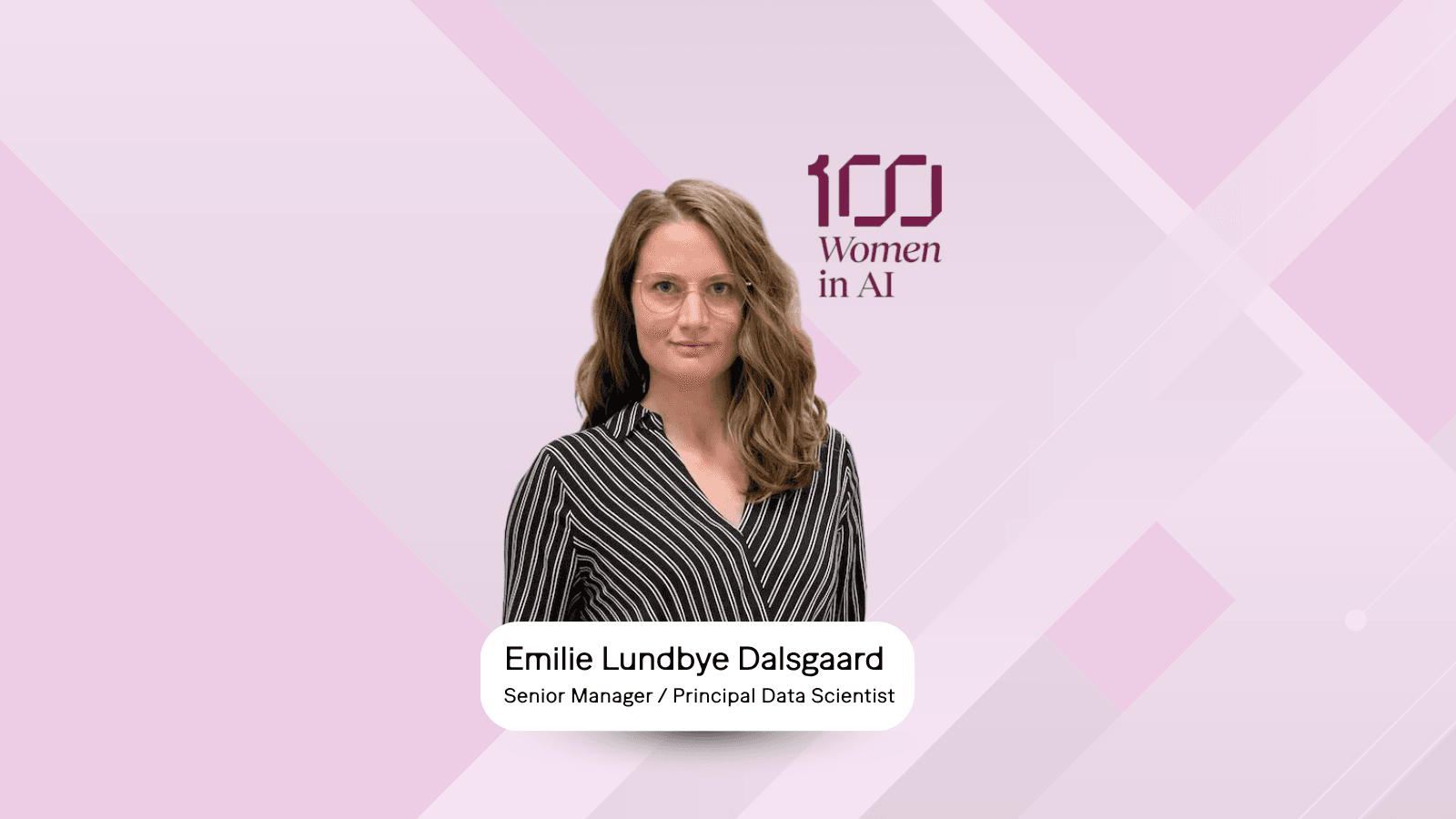
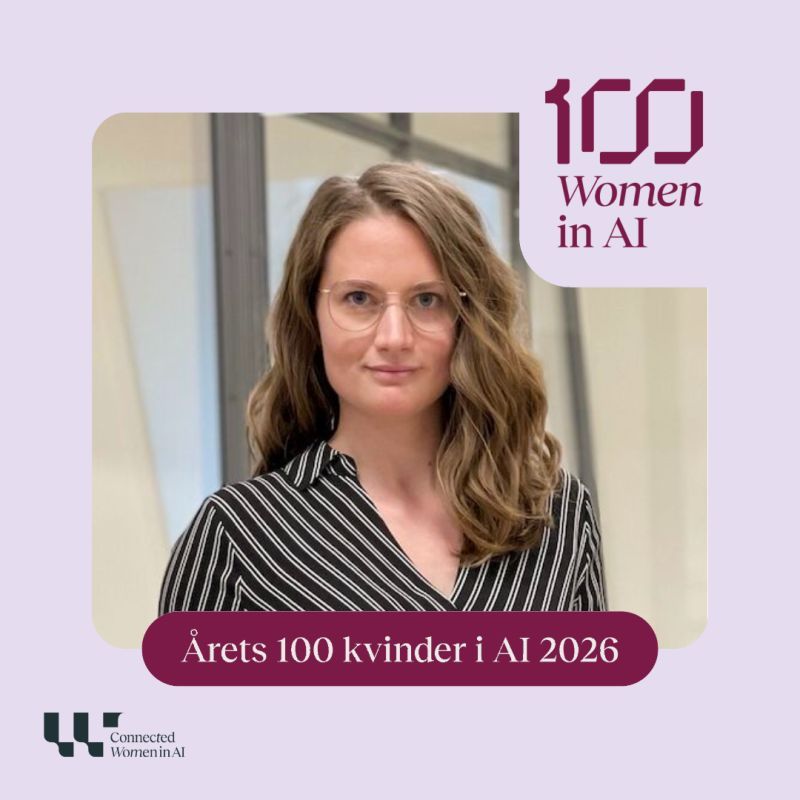
Our own Emilie Lundbye Daalsgard was named one of 100 Women in AI Denmark, a recognition that captures nearly a decade of work driven by a single question: How can AI solve real-life problems for real people? We sat down with her to talk about her path into AI, owning one’s expertise, and what it means to show up as yourself—colourful dress and all.
Take us back to the beginning. What's the story of how you ended up in AI?
It was never my original intention. I thought math was really fun when I was young and ended up going to university to become an engineer in mathematics. But I got to a certain level of theoretical mathematics that felt too abstract and not applicable enough, so I slowly pivoted towards data statistics and then machine learning. I was very focused on the applications: Is this actually something that I can connect to real life, to a problem? Is this data that represents a story, some events, some population somewhere?
Was there a moment you seriously questioned whether this field was for you? What kept you going?
Yes, at two important points. First, when I was originally starting out. I got into a technical university never having coded, and when we started having our first courses in programming, I didn't catch on immediately. I thought I was going to be so far behind, and then all of a sudden I found out I can still keep up, I’m still as good as people who have done this forever.
I also felt it coming back from maternity leave after close to nine months. AI has been booming while I was away, and I struggled with the balance: How much should I do in order to keep up? Can I even keep up? The ways of working are so different the last nine or 10 months compared to the eight or nine years I've been working in it. I trust my expertise, but at the same time you're being bombarded with all these new models, all these new frameworks. I don't think I'm caught up yet. I don't think I will ever truly feel like I caught up on everything that happened while I was away.
Tell us about a project you’ve done that sticks with you.
Early in my time at ADC we built a Conversational AI solution for a large bank—an LLM[1.1][2.1] to help answer customer enquiries, either by supporting call centre employees or going directly to the customer through full automation. What struck me was that the model itself ended up being the least complex part. The harder work was everything around it: the pipelines, deployment patterns, testing, governance, and helping the organisation actually adopt it. [3.1]It was inspiring to see how many different ADC competencies came together in one project, and how much we learned from each other in the process.
What does being named one of the “100 Women in AI Denmark” mean to you personally?
I was a little bit hesitant about putting myself forward. I had stepped away for maternity leave, and I was focused on this entirely new version of myself and this new human life. I felt all my colleagues had done much more impressive work this and last year while I was just getting back into things. I was also focused on the core of my work, the AI, the technical implementations, and wanting to prove myself here. But getting that recognition for what I've done so far meant a lot. It's not just what I'm producing right now, but just as much my journey and what I'm representing. I've been in this field for a decade, and I've been lucky enough to be part of incredible AI projects while still learning and growing.
You wrote: “Some of the strongest people I’ve collaborated with in this field are women. And many of them still receive far less visibility than their work deserves.” Why do you think this is? How do we change that?
Men are sometimes better at being louder about the work and their impact and their own abilities and capabilities. I think for many women it doesn't come naturally. It didn't for me.
For me it helped to reframe it. There might be someone somewhere with more theoretical knowledge on a set topic, but on this particular project and application I’m working on, I’m the expert. It took some guts, but it’s what really changed the perspective for me.
Initiatives like 100 Women in AI are opening up the door and saying there are so many different ways you can be you in this field, and that you can get recognised, and that you can be a role model.
What does it take for a woman to thrive in this industry?
I think the focus should be much more on what we can do structurally to create a more inviting space for women—how can we make sure that we attract them, keep the talent, and help them progress into senior management? I would much rather push back: What can workforces, what can the teams, what can the offices do in order to help women thrive more?
You recently came back from maternity leave, and one bit of the advice you gave that 100 Women in AI highlighted was to “Show up as your genuine self — you have more to offer than you think in this field.” Do these two things intersect for you? Has motherhood changed how you think about leadership, work, or the role you play in AI?
Motherhood has led to me being a little bit more direct both in my general communication, about priorities and what I can commit to. I hope other people see it as a good thing!
But when I gave that piece of advice, I thought back to earlier in my career and previous jobs, where I was often the only woman on the team. To fit in, I tried so hard to create a good professional version of myself that ended up being a duller, more boring version, basically. And at some point I just thought, no. I would actually much rather show up as myself—in my humor, my personality, my way of expressing myself—while also wearing a colourful flower dress, if I want to. And I found I can still participate just as well in IT discussions.
In the same way, when you get to leadership positions, it's just as important to show up as yourself. You have the responsibility to bring your own kind of leadership into the conversation, not just replicating the leadership styles currently in power.
What feels genuinely exciting to you in AI right now?
I'm amazed at how fast we have democratised Generative AI and AI agents. Basically everyone can now vibecode and build using agentic AI. Even very non-tech people are now discussing AI in their everyday life. For the first time ever my family somewhat understands what I'm doing. This Easter my mom and I discussed transformer models and APIs. That's definitely a first!
What’s something you wish someone had told you earlier in your career?
Giving 100% doesn’t mean operating at full speed every day on everything. It means managing your energy so you can perform at your best when it really matters. Sometimes you intentionally give 80% on lower‑stakes tasks so you can give 120% when it counts.
Date
June 17, 2026
Our own Emilie Lundbye Daalsgard was named one of 100 Women in AI Denmark, a recognition that captures nearly a decade of work driven by a single question: How can AI solve real-life problems for real people? We sat down with her to talk about her path into AI, owning one’s expertise, and what it means to show up as yourself—colourful dress and all.
Take us back to the beginning. What's the story of how you ended up in AI?
It was never my original intention. I thought math was really fun when I was young and ended up going to university to become an engineer in mathematics. But I got to a certain level of theoretical mathematics that felt too abstract and not applicable enough, so I slowly pivoted towards data statistics and then machine learning. I was very focused on the applications: Is this actually something that I can connect to real life, to a problem? Is this data that represents a story, some events, some population somewhere?
Was there a moment you seriously questioned whether this field was for you? What kept you going?
Yes, at two important points. First, when I was originally starting out. I got into a technical university never having coded, and when we started having our first courses in programming, I didn't catch on immediately. I thought I was going to be so far behind, and then all of a sudden I found out I can still keep up, I’m still as good as people who have done this forever.
I also felt it coming back from maternity leave after close to nine months. AI has been booming while I was away, and I struggled with the balance: How much should I do in order to keep up? Can I even keep up? The ways of working are so different the last nine or 10 months compared to the eight or nine years I've been working in it. I trust my expertise, but at the same time you're being bombarded with all these new models, all these new frameworks. I don't think I'm caught up yet. I don't think I will ever truly feel like I caught up on everything that happened while I was away.
Tell us about a project you’ve done that sticks with you.
Early in my time at ADC we built a Conversational AI solution for a large bank—an LLM[1.1][2.1] to help answer customer enquiries, either by supporting call centre employees or going directly to the customer through full automation. What struck me was that the model itself ended up being the least complex part. The harder work was everything around it: the pipelines, deployment patterns, testing, governance, and helping the organisation actually adopt it. [3.1]It was inspiring to see how many different ADC competencies came together in one project, and how much we learned from each other in the process.
What does being named one of the “100 Women in AI Denmark” mean to you personally?
I was a little bit hesitant about putting myself forward. I had stepped away for maternity leave, and I was focused on this entirely new version of myself and this new human life. I felt all my colleagues had done much more impressive work this and last year while I was just getting back into things. I was also focused on the core of my work, the AI, the technical implementations, and wanting to prove myself here. But getting that recognition for what I've done so far meant a lot. It's not just what I'm producing right now, but just as much my journey and what I'm representing. I've been in this field for a decade, and I've been lucky enough to be part of incredible AI projects while still learning and growing.
You wrote: “Some of the strongest people I’ve collaborated with in this field are women. And many of them still receive far less visibility than their work deserves.” Why do you think this is? How do we change that?
Men are sometimes better at being louder about the work and their impact and their own abilities and capabilities. I think for many women it doesn't come naturally. It didn't for me.
For me it helped to reframe it. There might be someone somewhere with more theoretical knowledge on a set topic, but on this particular project and application I’m working on, I’m the expert. It took some guts, but it’s what really changed the perspective for me.
Initiatives like 100 Women in AI are opening up the door and saying there are so many different ways you can be you in this field, and that you can get recognised, and that you can be a role model.
What does it take for a woman to thrive in this industry?
I think the focus should be much more on what we can do structurally to create a more inviting space for women—how can we make sure that we attract them, keep the talent, and help them progress into senior management? I would much rather push back: What can workforces, what can the teams, what can the offices do in order to help women thrive more?
You recently came back from maternity leave, and one bit of the advice you gave that 100 Women in AI highlighted was to “Show up as your genuine self — you have more to offer than you think in this field.” Do these two things intersect for you? Has motherhood changed how you think about leadership, work, or the role you play in AI?
Motherhood has led to me being a little bit more direct both in my general communication, about priorities and what I can commit to. I hope other people see it as a good thing!
But when I gave that piece of advice, I thought back to earlier in my career and previous jobs, where I was often the only woman on the team. To fit in, I tried so hard to create a good professional version of myself that ended up being a duller, more boring version, basically. And at some point I just thought, no. I would actually much rather show up as myself—in my humor, my personality, my way of expressing myself—while also wearing a colourful flower dress, if I want to. And I found I can still participate just as well in IT discussions.
In the same way, when you get to leadership positions, it's just as important to show up as yourself. You have the responsibility to bring your own kind of leadership into the conversation, not just replicating the leadership styles currently in power.
What feels genuinely exciting to you in AI right now?
I'm amazed at how fast we have democratised Generative AI and AI agents. Basically everyone can now vibecode and build using agentic AI. Even very non-tech people are now discussing AI in their everyday life. For the first time ever my family somewhat understands what I'm doing. This Easter my mom and I discussed transformer models and APIs. That's definitely a first!
What’s something you wish someone had told you earlier in your career?
Giving 100% doesn’t mean operating at full speed every day on everything. It means managing your energy so you can perform at your best when it really matters. Sometimes you intentionally give 80% on lower‑stakes tasks so you can give 120% when it counts.
About ADC
ADC is a European data and AI consultancy. Wayfinders for what's next, we help organisations navigate complexity and turn AI ambition into real impact. With over 200 professionals across Amsterdam, Copenhagen, Stockholm, and Utrecht, we combine scientific rigour, engineering craftsmanship, and a people-centred approach to AI. Together with CLEVER°FRANKE, our data design studio, we deliver end-to-end solutions trusted by leading organisations across financial services, life sciences, retail, transportation, public & society, and agriculture & food.